Laura Alcaine Bonasa
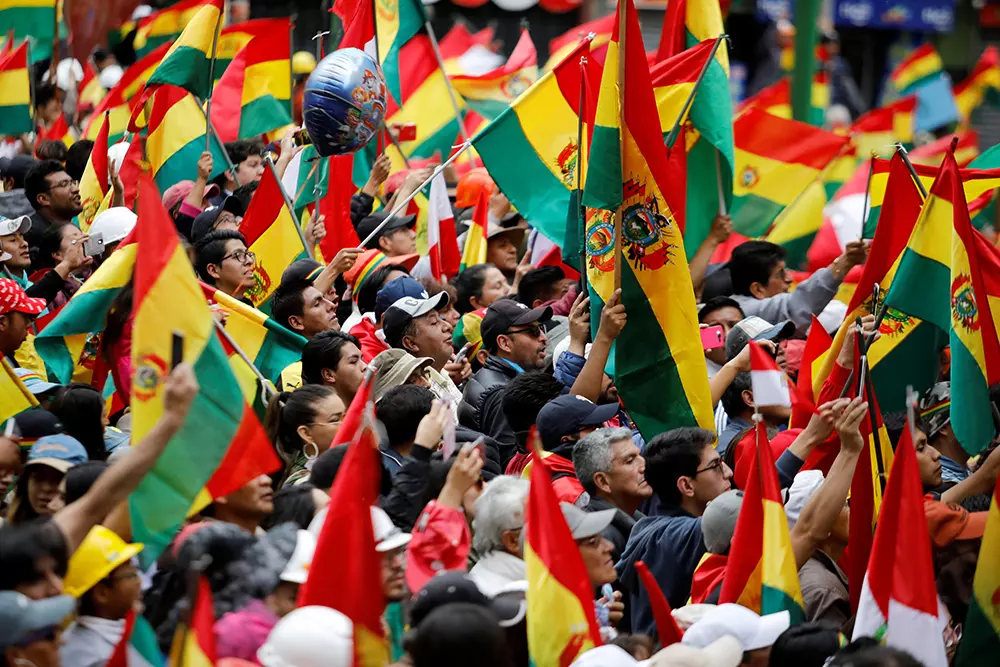
In December 2005, 84% of eligible Bolivians turned out to vote for president. It was the highest turnout since the country’s return to democracy, and the winner, Evo Morales, became the first Bolivian president elected by an absolute majority in decades. Two decades later, that same country sits at number 103 in The Economist’s Democracy Index, classified as a «hybrid regime»: neither fully authoritarian nor fully democratic. Between those two dates lies the story of how a country can vote enthusiastically to save its democracy and, without quite noticing, end up hollowing it out from within.
The year everything worked
Bolivia arrived at 2005 broken. Between 2003 and 2006, following what became known as the Gas War, the country had seen four different presidents come and go in barely three years, amid constant political instability and grassroots protests. Evo Morales, a coca-growers’ union leader of Indigenous roots who had spent nearly a decade building the Movement for Socialism (MAS), capitalized on that exhaustion with an anti-neoliberal message critical of foreign investment. He won with 53.74% of the vote, and that election was historic for another reason too: for the first time, deputies, senators, and prefects were elected across all nine of the country’s departments, with the MAS winning in five of them.
Morales convened a Constituent Assembly, nationalized hydrocarbons, redistributed 2.2 million hectares of land to peasants and Indigenous communities and, in 2009, promulgated a new Constitution redefining Bolivia as a «Unitary Social State of Plurinational Communal Law.» The Economist Intelligence Unit’s (EIU) democracy index captured that momentum: in 2008, Bolivia reached its best score in decades, 6.15 points, crossing the threshold into «flawed democracy.» But even then there was a crack beneath the surface: that rise depended more on democratic enthusiasm and social mobilization than on solid bureaucratic institutions or genuine independence between branches of power.
2019: the year all of Latin America watched Bolivia fall
That crack split wide open eleven years later. In 2019, Bolivia suffered the single largest democratic setback in all of Latin America according to the EIU, its score dropping from 5.70 to 4.8, the fall from «flawed democracy» to «hybrid regime.» The trigger was Morales’s own re-election bid: the Supreme Electoral Tribunal declared him the first-round winner with 47.08% of the vote against Carlos Mesa’s 36.51%, but the Organization of American States found «very serious irregularities» and «vote manipulation.» Morales was, moreover, seeking a fourth term despite a Constitution that allows only two. Protests paralyzed entire cities, and the crisis ended when the military itself turned its back on him and invited him to resign.
That year’s breakdown is particularly revealing: the EIU hit Bolivia hardest in two categories, political culture (3.75 points) and functioning of government (3.93), while civil liberties held up somewhat better (6.76). In 2020, in the middle of the pandemic, after elections that were widely regarded as legitimate, the country climbed back to 5.08 points. But the warning signs had already been there: Bolivia now belonged, alongside Venezuela and Nicaragua, to the group of countries where anti-democratic practices had become a recurring feature of the entire decade.
A judiciary that stopped being a branch of power
By 2024, Bolivia had consolidated its status as a hybrid regime with a score of 4.26. The most striking figure in that year’s breakdown isn’t economic or electoral: it’s that the «political culture» category collapsed to 1.88 points, the sharpest drop of the five variables the index measures. Behind that number lies a very specific mechanism that the Carnegie Endowment has described as typical of Latin American hybrid regimes: the «colonization» of the judiciary to guarantee impunity for the executive branch, turning the rule of law into rule by law.
In Bolivia, that mechanism has a name: the «self-extension» of the magistrates of the Plurinational Constitutional Court and the Supreme Court of Justice, who remained in office without having been re-elected because the judicial elections mandated by the Constitution simply never took place on time. That same «self-extended» court was later the one responsible for ruling on which candidacies were valid ahead of the August 2025 elections. The result is a judiciary that no longer functions as a check on executive power, but as its instrument: legal proceedings that are activated or shelved depending on the identity of the accused, magistrates and senior police officials implicated in corruption and sexual abuse scandals without any legal consequence, and the increasingly frequent use of «lawfare» to sideline political opponents through the courts rather than at the ballot box.
When neither winning nor losing at the polls means anything anymore
Accountability, the mechanism through which citizens can punish their governments whether at the ballot box or through social and media pressure, is, in political scientist Leonardo Morlino’s framework, one of the pillars of democratic quality. In Bolivia, both channels are blocked. The horizontal one is blocked because oversight institutions, starting with the Constitutional Court itself, depend on the same legal vacuum that keeps them in office, leaving them with neither the capacity nor the will to sanction executive overreach. The vertical one is blocked because, when an unelected judiciary decides in advance which candidacies can run, as happened in the internal power struggle between the factions of Luis Arce and Evo Morales, citizens can no longer meaningfully hold those in power accountable at the ballot box: the electoral options have already been politically filtered before anyone votes. It is no coincidence that, with only two weeks left before the 2025 general election, null and blank votes came to outnumber those cast for the actual opposition candidates.
Added to this is a third blockage: the State’s own capacity to listen to what people are demanding. While the ruling party fractured between «Arcistas» and «Evistas» and citizens protested in the streets over the economic crisis and the dollar shortage, the State’s energy was consumed by deciding who would keep their seat on the Constitutional Court. The Inter American Press Association warned in 2025 of rising violence against journalists and government-imposed media restrictions. This is a crucial point: when the press comes under attack, those in power become increasingly disconnected from the very demands they should be addressing, leaving them more reliant on propaganda or repression than on democratic responsiveness.
The debt that never gets settled
Bolivia also carries a structural debt that no democracy index quite manages to measure: over 40% of its population identifies as Indigenous, and that same population suffers poverty rates nearly three times higher than urban areas, trapped in an extractive economic model (gas, mining) that generates state revenue but creates little employment or sustainable economic opportunities for rural communities. It is the same population that brought Evo Morales to power in 2006 precisely because he promised to include it after two centuries of exclusion dating back to independence in 1825. Almost twenty years later, that exclusion remains, by the country’s own data, its main unresolved social challenge.
Bolivia has not, in the strictest sense, stopped being a democracy: it still has a constitution, courts, and elections. What it has lost is the substance that makes all of that mean anything. The country that in 2005 lined up for hours to freely vote for its deputies, senators, and prefects for the very first time is the same country where today no one, not the ordinary citizen, not the opposition, not even Congress itself, has any real way of making their vote count against a power that has learned to control who gets to run before anyone ever casts a ballot.
Este artículo se incluye dentro de la Cátedra Jean Monnet «European Union’s external relations and Spanish Foreign Policy».